Monday, 9 February 2009
GP2: Good Practice by Good Practitioners
Saturday, 31 January 2009
GP2: Good Practice by Good Practitioners
Staying in Touch with Stress and Yourself
"Good" practitioners develop their character (virtues and resiliency) and competence (skills and knowledge), as part of their ethical commitments to do good and to provide quality services. Growing as good practitiners also means that we stay in touch with our inner world, stress levels, and the need to give/reveive feedback and support from trusted friends and colleagues.Here is a tool that we have found uselful to help monitor our stress levels as well as the stress levels of mission/aid workers. It helps us stay in touch with how we are doing in the face of the demands of work, expecialy in "field" contexts. This tool is used by the International Federation of the Red Cross and Red Crescent Societies and many other organizations (from the booklet Managing Stress in the Field, 2001). The booklet is very helpful and available to download for free at:
http://www.ifrc.org/cgi/pdf_pubshealth.pl?stress.pdf
Short Questionnaire on Stress
Instructions: Rate each of the following items in terms of how much the symptom was true of you the last month.
0 = Never 1 = Occasionally 2 = Somewhat often 3 = Frequently 4 = Almost always
*
___1. Do you tire easily? Do you feel fatigued a lot of the time, even when you have gotten enough sleep?
___2. Are people annoying you by their demands and stories about their daily activities? Do minor inconveniences make you irritable or impatient?
___3. Do you feel increasingly critical, cynical or disenchanted?
___4. Are you affected by sadness you can’t explain? Are you crying more than usual?
___5. Are you forgetting appointments, deadlines, personal possessions? Have you become absent-minded?
___6. Are you seeing close friends and family members less frequently? Do you find yourself wanting to be alone and avoiding even your close friends?
___7. Does doing even routine things seem like an effort?
___8. Are you suffering from physical complaints such as stomach aches, headaches, lingering colds, general aches and pains?
___9. Do you feel confused or disoriented when the activity of the day stops?
___10. Have you lost interest in activities that you previously were interested in or even enjoyed?
___11. Do you have little enthusiasm for your work? Do you feel negative, futile, or depressed about your work?
___12. Are you less efficient than you think you should be?
___13. Are you eating more (or less), smoking more cigarettes, using more alcohol or drugs to cope with your work?
Total Score: (Add up scores for items 1-13)
*
Interpretation: No formal norms are available for this measure. Based on the content of the items, a score of 0-15 suggests the delegate is probably coping adequately with the stress of his or her work. A score of 16-25 suggests the worker is suffering from work stress and would be wise to take preventive action. A score of 26-35 suggests possible burnout. A score above 35 indicates probable burn out.
Based on “The Relief Worker Burnout Questionnaire” in Coping with Disaster (1999) by John H. Ehrenreich.
Reflection and Discussion
1. Based on the above tool, what are some of the main areas of stress for you?
2. What are a few things you could do to help deal with such stress?
3. Who do you know that would benfit from using this tool?
Thursday, 22 January 2009
GP2: Good Practice by Good Practitioners
Practicing Positive Psychology
Saturday, 17 January 2009
GP2: Good Practice by Good Practitioners
Morality must match with capacity.Wednesday, 31 December 2008
Member Care and Doing Good IV
*
I once thought that my feet
were shod
with special ornate sandals.
Winged sandals to let me soar
as a special person.
But I was wrong.
Instead I learned that my feet
were shorn
with a common iron nail.
A wingless nail to help me limp
as a common person.
I am human not Hermes.
Pierced feet to follow the Pierced-One.
*
Now and again.
Monday, 29 December 2008
Member Care and Doing Good III
I once thought *
But I was wrong.
*
Instead I learned
my feet were being anointed.
*
For my burial.
*
I was to die
for those I claimed to love.
*
For colleagues.
For a field.
*
For certain and uncertain friends.
For certain and uncertain enemies.
For everything.
*
And again.
Saturday, 27 December 2008
Member Care and Doing Good II
Sandro Botticelli, 1500, detail from Mystic NativityMay we see beauty and do good
“Be totally ready
to receive the gift that’s coming
when Jesus arrives [again].”
I Peter 1, The Message
Wednesday, 24 December 2008
Member Care and Doing Good I
Marley's Ghost visits Scrooge. (written 1843, original illustration by John Leech )
This is one of the most powerful literary stories that I know:
imploring humans to do good, deploring humans for not doing good.
*****
*
*
*
*
Reflection and Discussion
What time is it?
1. The time for doing good, is now.
2. The time for avoiding good, is now.
3. The time for confronting evil is also now.
4. The time for ignoring evil, is now.
What time does your member care clock say?
Sunday, 30 November 2008
Member Care and Organisational Health
I am back at Ards Friary, Donegal Ireland. In my mind. In my heart. I come here often. Thinking about healthy organisations. Thinking especially about healthy faith-based organisations. Orwell has been so helpful. But what are the positive examples? How did the Franciscan monks for example, such as here at Ards Friary, maintain a healthy organisational life--and a healthy community?
How rewarding it is to work in an organisation, a community, a team, a network, with these features:
1. Mutual respect among staff
2. Fair pay/compensation
3. Opportunities to make contributions
4. Opportunities for advancement and personal growth
5. Sense of purpose and meaning
6. Management with competence and integrity
7. Safeguards to protect individuals (staff and customers) from injustice
8. Responsibility for actions: owning mistakes, not blaming others or covering up
9. Honesty in communication and public disclosures: not slanting the truth or exagerating
10. Accountability for personal/work life: seeking out feedback and ways to improve, not ignoring or pretending
*
Reflection and Discussion
1. How would you add to or adjust the above list?
2. What are the three core characteristics in an organisation that would make you want to be part of it and really contribute?
Thursday, 6 November 2008
Member Care: Tares, Tears, and Terrors

(Matthew 7:15)
*
False christs. Anti-christs.
(Matthew 24:24; I John 2:18)
*
Evil men. Imposters. Deceivers.
(2 Timothy 3:13)
*
Frauds. Snakes. Reptilian sneaks.
(Matthew 23: 29,33)
*
Professional liars. Deceitful/crooked workers.
(I Timothy 4:2; 2 Corinthians 11:13)
*
False brethren. So-called brother—wicked man.
(Galatians 2:4; I Corinthians 5:11-13)
*
False prophets. False apostles. False teachers.
(Matthew 7:15; Matthew 24:1,24; 2 Corinthians 11:13; 2 Peter 2:1)
*
Deceived hypocritical liars
(I Timothy 4:2; 2 Timothy 3:8)
*
Hidden reefs, waterless clouds,
(Jude 12-13)
*
Don’t be naïve.
(Matthew 10:17)
Monday, 27 October 2008
Member Care and Member Terror
Milan Kudera, quoted in the Economist, 18 Oct. 2008, p. 92
*****
On one end of the continuum lies subtle manipulation.
On the other end is found blatant extermination.
It can be a person, party, process, or principle.
It controls through fear and falsehood.
It distorts, deceives, and destroys.
It terrorizes to maintain power.
It is Member Terror.
*****
p. 119
The past was not simply altered, rather it had been obliterated.
p. 120
Commonly, if the Party was displeased with you, you simply disappeared and no one ever heard from you again.
p. 129
Orthodoxy means that you do not think and that you do not need to think.
p. 136
Why should you feel that something was very inappropriate unless you had some kind of distant memory that reality was actually different in the past?
p. 143
Until people become aware/awake, they will not protest their condition, and until they have protested their condition, they will never be truly aware/awake.
p. 153
No one ever escaped from the Thought Police. The victims were like corpses that would be soon returned to their graves.
p. 158
Freedom means that you can freely say that two plus two make four. If this is allowed, then the rest follows.
p. 163
The hope for society lay with the proles [common people, the proletariat]. It seemed reasonable, until you observed the rank and file walking past you in the street. Your hope was based more on faith than reality.
p. 167
We will force who you really are out of you, and then we will replace the emptiness with ourselves.
p. 332
You cannot do anything against the lunatic who is smarter than you, especially the lunatic who listens to your logical concerns fairly, and yet still acts like a lunatic.
p. 338
No, Winston, you yourself are only to blame for your dire and thoroughly dehumanized condition. This is the consequence of your having opposed the Party.
p. 347
*
1. People play dirty.
The Who, Won’t Get Fooled Again, 1971
*
http://www.youtube.com/watch?v=aQUAxN9Sxdo
Monday, 20 October 2008
Member Care and Member Tear
Christopher Hitchens, 2003, Introduction.
**Servility is a dysfunctional form of the servanthood extolled in the New Testament.
**Exchanging freedom for security is a dysfunctional form of laying down one’s life extolled in the New Testament.
How endemic and/or epidemic is this in the mission/aid sector?
Note: The context for the next five paraphrased quotes involves naivete, manipulation, and lies:
1. "Loyalty and obedience are more important than bravery."
2. "You have probably only dreamed these things, comrades.
…the animals were content to think that they had made a mistake in their thinking."
3. "I can't believe that this would happen here on our farm. I don't get it. We must be wrong. I am just going to have to work harder to solve this."
4. "The animals were one again bewildered, but with the able convincing of Squeeler they once again believed that it was their own memories that were faulty."
***
And now the ending of Animal Farm:
"Twelve angry voices were shouting, each of them like the other…pig shouting at man, and man shouting at pig, and pig at man again; but it had already become impossible to tell them apart. "
*
Reflection and Discussion
**The essence of Member Tear is to distort the truth in a way that hurts others. Comment on this assertion.
**Pigs become humans and humans become pigs. For Orwell, this means that people can and do have the propensity to become evil and exploit others. Comment on why this propensity—Member Tear-- might be hard to understand, accept, and to change.
Friday, 10 October 2008
Member Care and Member Tares
I am pouring over two books written by George Orwell in the mid-late 1940s: Animal Farm and 1984. Orwell’s prescience is nothing short of remarkable. Totalitarian states that prey upon the vulnerable have always been, are present now, and probably will always be. Or to blend some of Orwell’s terms with Christ’s: the poor we will always have with us….along with the pigs, the proles, and the Thought Police.
*
I am also reminded of Christ’s concluding remarks in the parable of the unjust steward: "The children of this world are, in their own generation, wiser than the children of the light" (Luke 16:8). These books are a helpful balance for those who claim to be “children of the light” including myself, who are prone to emphasise the good in people and to give most folks the benefit of the doubt. I call this emphasis “wheat wisdom” as opposed to “street wisdom”, the latter which is far more familiar with the "member tares" and the “tactics of tares” in our midst, as mentioned in Matthew 13.
*
So in light or Orwell and the New Testament (and even though I am really wanting to dwell much more on esthetically-pleasing things), I am thinking about hindrances for people to understand and act on truth. I am thinking about how we often conform reality to our minds and not vice versa. I am thinking that oftentimes people and groups do so intentionally and maliciously. And I am thinking about an important theme in the book of Hebrews: there is a true reality—the Kingdom of God— that cannot be shaken.
*
Note that many of the comments from Orwell that will be quoted reflect the intention to enslave rather than enlighten. Stay tuned.
Friday, 19 September 2008
Member Care and Moral Courage
Your task is to be true not popular.Your true being brims over into true words and deeds.
Luke 6, The Message
paraphrased from The Myth of Transparency, Zachary Karabell, Newsweek July 14, 2008, page 47
**Think of a time when telling the truth was very costly for you personally.
**Think of a time in the near future when telling the truth may also be very costly.
**Do you have the moral courage to be more true than popular?
Monday, 8 September 2008
Member Care and Moral Courage
Saturday, 30 August 2008
Member Care and the Body of Christ
This is undoubtedly my favourite painting in El Prado museum. It was done by Antonello Da Messina circa 1476, oil on panel. The most striking aspect for me is the beautiful yet anguished face of the angel, grieving over the broken, beloved Christ.
I too grieve. I grieve for the broken, beloved member care body of Christ. I grieve when inflicte it with injury, either by ignorance or by intentionality. This can change.
Si oblitus fuero tui Hierusalem oblivioni detur dextera mea.
*
2. Sometimes people acknowledge how they have participated in the wounding of the Body, through ignorance and/or intentionality. They apologize and they offer restitution. They are genuinely contrite and they change their ways. Give a few examples.
*
3. When we love and heal the Body, we love and heal Christ. Comment on this statement in light of this verse: “…the church is Christ’s Body, the fullness of Him who fills all in all.” (Ephesians 1:23).
Saturday, 23 August 2008
Member Care and the Body of Christ
This week we remember the victims of the airline tragedy in Madrid. We also remember their families and friends. It is not time for us to reflect on Renaissance art, but rather to mourn humans who are works of art.*
Monday, 18 August 2008
Member Care and the Body of Christ
We are looking at "wounds" in the Body of Christ. We are relating specific paintings of Christ's "passion" from El Prado Museum in Madrid, to the mission/member care world. The level of health/dysfunction (wounds) in our own communities will be reproduced in the communities that we seek to strengthen and form.
The painting below, The Descent from the Cross, was done around 1435 by the Flemish artist Rogier van der Weyden. Who among us also has the moral courage to request and to hold and to care for the broken Body?

Reflection and Discussion
Lamb of God you take away the sin of the world, have mercy on us.
Is there something within your sphere of influence that needs justice and mercy? Mercy with justice brings healing--for our communities and those we seek to support/form.
*
We will not prosper if we cover a transgression.
But if we confess and forsake our transgressions, we will find mercy.
Proverbs 28:13
Monday, 11 August 2008
Member Care and the Body of Christ
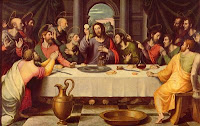
Hoc est corpus meum quod pro vobis datur.
--”What are those wounds between your arms?”
--“Those with which I was wounded in the house of my friends.”
Zechariah 13:6
Reflection and Discussion
The Body of Christ is amazingly beautiful. People through the ages, like the apostles depicted in the above painting, are in awe of it. One of the apostles however appears to be indifferent at best, and would soon further betray the Body. Think of some ways to apply this comment--and this painting--to the mission and member care communities.
Thursday, 31 July 2008
Member Care and Human Rights--12, Final
Tuesday, 22 July 2008
Member Care and Human Rights--11
It is about civil rights—which are based on human rights—and justice.
The movie is about a famous court case in the USA involving a prominent black civil rights leader who was assassinated in 1963 (Medgar Evers). The main suspect of this hate-crime was a man known to be a real advocate of white supremacy. He was not convicted since the jury could not come to a conclusion. In fact, there were two trials, but the same conclusion: a “hung” jury and no conviction.
Some 30 years later (1993) the case was reopened (after much opposition) and retried. This time the man was found guilty, and brought to justice.
This story is an outstanding and sobering account of what it takes to see human rights upheld and to see justice done. Whether it involves supporting the welfare of mission/aid staff or publically advocating on behalf of oppressed people groups, justice can in fact be achieved. But it is not easy. Idealism and good will are almost never enough. Some lessons that come out clearly from this movie:
**1. “Ghosts of injustice” will haunt you unless you confront them. They will likely huant you even more if you confront them--until justice is done.
**2. Justice does not happen usually unless one actively pursues it.
**3. There are intentional hindrances to uncovering and disseminating “facts”: cover-ups, lost information/evidence, harassment.
**4. It takes time, patience, and professionalism, not to mention key support, for justice to be done.
**5. People are often unwilling to help: to inconvenience themselves, to threaten their livelihood, to be ostracised by others and above all to “change one’s way of life”. This is true of individuals, organisations, communities, and countries.
**6. There are some people however who cannot simply look the other way and ignore gross injustice. These people are resolutely committed to pursue truth and justice, and will not take “no” for an answer. They are willing to face extreme negative consequences, including defamation and sometimes even death, in order to act with integrity and help others.
**7. Perpetrators of injustice and their accomplices often fall into their own traps.
**8. Eventually, society and organisational ethos can change but it usually takes a lot of hard work, over time, crises, confrontation, regime changes, and new leaders to see it come about.
**9. Don’t give up. Note that today, the state of Mississippi in the USA has more elected officials who are black than any other American state.
**10. etc.!
Reflection and Discussion
1. Watch a 12 minute interview from 1996 with the widow of Medgar Evars and the Assistant District Attorney that successfully reopened/prosecuted this case. One interesting addition to the movie based on this interview is the ongoing, pervasive prayer that accompanied the pursuit of justice (watch minutes 22 through 34)
http://www.youtube.com/watch?v=OOOpsbFzqc0
2. Listen also to the special report from 2003 to commemorate the 40th anniversary of Medgar’s assassination. It is done by National Public Radio’s “All Thing’s Considered.”
http://www.npr.org/templates/story/story.php?storyId=1294360
Monday, 14 July 2008
Member Care and Human Rights--10
John L. Amstutz
Excerpts, from Doing Member Care Well, chapter 4
“Inasmuch as you have done it to one of these the least of My brothers, you have done it to Me” (Matthew 25:40). Few verses are used more frequently than this verse by Christian humanitarian organizations…But is unconditional humanitarianism the point of the parable of the sheep and goats in Matthew 25?...
Simply stated, the parable of the sheep and goats pinpoints the basis of judgment of the nations. Jesus, when He comes in His glory as the Son of Man, will separate the nations (ethne) of the earth into two groups, sheep and goats. The basis of this division will be their response to “the least of these my brethren.”…
A survey of commentators indicates that the majority hold “the least of these My brethren” to be oppressed and suffering humanity…But again, we ask, is such unconditional humanitarianism the point of the parable?...Who are Jesus’ brothers? Those who are hearers and doers of His word, namely, those who are His disciples who “continue in His word” (John 8:31). Such close identity of Jesus with His disciples is clearly taught in Matthew 10:40-42. "He who receives you receives Me, and he who receives Me receives the one who sent me..." Therefore, one’s response to Jesus’ disciples is one’s response to Jesus Himself and to the Father who sent Him. Is not this reality the basis of Jesus’ question to Saul on the Damascus road, “Why do you persecute Me?” (Acts 9:1-5)?. Had not Saul’s persecution of believers in Jerusalem, in fact, been a persecution of Jesus Himself? It seems so.
If this is a proper interpretation of the word “brethren,” then the point of the parable of the sheep and goats is even more pointed...Apparently the universal proclamation of the gospel of the kingdom will be accompanied by a universal positive and negative response to that proclamation in that some will show kindness to persecuted believers/disciples while others will not...Such response to Christ’s messengers indicated their response to their message and to the One who had sent them, Jesus Himself.
The implications of such an understanding of this parable are significant. First, the parable assumes the universal preaching of the gospel is not optional in the plan of God. “Missions” is not an appendage on the Church’s agenda. It is essential. A worldwide witness is the foundation for the judgment of the nations.
Second, accompanying this universal witness to Jesus Christ will be persecution. Indeed, “all who desire to live godly in Christ Jesus will be persecuted” (II Timothy 3:12). Opposition for one’s faith in Christ is not just for believers in the Middle East and Asia. Christ’s disciples will be “hated by all nations” because they are in all nations.
Third, the place of hospitality and kindness toward followers of Jesus Christ is no small matter, particularly toward those who are being persecuted for their faith in Him. “Remember those in prison as if you were their fellow prisoners, and those who are mistreated as if you yourselves were suffering” (Hebrews 12:3). “By this shall all men know that you are my disciples if you have love for one another” (John 14:35). In the words of the Apostle Paul, “Let us do good to all men, especially to those of the household of faith” (Galatians 6:10).
Summary Thoughts
Is it not time we free this pointed parable of the sheep and the goats to speak clearly and fully of the crucial place of the universal preaching of the gospel to every nation (ethne) and the opposition and persecution that will attend such preaching? And is it not time we free this pointed parable to speak clearly and fully of the essential need of intentional humanitarianism—member care—toward those who have chosen to suffer loss for their witness to Christ in these nations?
Humanitarianism with a point is the point, and the point is “for, inasmuch as you have done it to one of the least of these My brothers, you have done it to Me”! And never has a proper understanding of this pointed parable been more important than it is as we enter the new millennium in which the Church increasingly focuses on the final frontiers, many of which are in risky and resistant areas.
Reflection and Discussion
**Do you agree with the author’s understanding of the identity of the “least of these My brethren”? Why or why not?
**What are some of the implications of the author’s understanding of the parable of the sheep and goats, for mission and for member care?
**What has been your response to persecuted followers of Christ?
Sunday, 6 July 2008
Member Care and Human Rights--9

*
The responsibility to help vulnerable people:
24:11--Deliver those who are being taken away to death, and those who are staggering to death, O hold them back.
24:12--If you say, "See, we did not know this," Does He not consider it who weighs the hearts? And does He not know it who keeps your soul? And will He not render to man according to his work?
*
Russian:
1: 3--усвоить правила благоразумия, правосудия, суда и правоты;
24: 11--Спасай взятых на смерть, и неужели откажешься от обреченных на убиение?
24:12--Скажешь ли: `вот, мы не знали этого'? А Испытующий сердца разве не знает? Наблюдающий над душею твоею знает это, и воздаст человеку по делам его.
18. Everyone has the right to freedom of thought, conscience and religion; this right includes freedom to change his religion or belief, and freedom, either alone or in community with others and in public or private, to manifest his religion or belief in teaching, practice, worship and observance.
19. Everyone has the right to freedom of opinion and expression; this right includes freedom to hold opinions without interference and to seek, receive and impart information and ideas through any media and regardless of frontiers.
20. (1) Everyone has the right to freedom of peaceful assembly and association.
(2) No one may be compelled to belong to an association.
*
Каждый человек имеет право на свободу мысли, совести и религии; это право включает свободу менять свою религию или убеждения и свободу исповедовать свою религию или убеждения как единолично, так и сообща с другими, публичным или частным порядком в учении, богослужении и выполнении религиозных и ритуальных обрядов.
Статья 19
Каждый человек имеет право на свободу убеждений и на свободное выражение их; это право включает свободу беспрепятственно придерживаться своих убеждений и свободу искать, получать и распространять информацию и идеи любыми средствами и независимо от государственных границ.
Статья 20
1. Каждый человек имеет право на свободу мирных собраний и ассоциаций.
2. Никто не может быть принуждаем вступать в какую-либо ассоциацию.
Reflection and Disucssion
Read the UDHR document two times in the next week.
Focus especially on the Preamble and Articles 18-20.
What are some ofthe key values, rights, and terms that you find?
Monday, 30 June 2008
Member Care and Human Rights--8
Recently a team of four psychologists was providing member care services to workers in an Asian country. These workers were a mixture of locals and internationals. Their perseverence and love for people were remarkable.
*
We listened a lot. And then we taught some. Here is a summary (part one of three) oriented for those in the faith-based community (Christian).
*****
Difficult experiences are every where, at every time, for every one. No one escapes. These expereinces include both: external stressors like persecution, harassment, and relationship conflict; and internal struggles like depression, fear, and frustration.
*
Philippians 1:1,2 and Ephesians 3:1
We are prisoners and bond-servants of Jesus Christ, for the sake of the gentiles.
We are not prisoners of governments nor of our circumstances.
Message to church in Smyrna--Revelation 2:8-11
You may go to prison but do not be afraid. Be faithful. Member care helps us to be faithful in all aspects of life--to do what we know is right—serving God and others. He will reward us.
*
Exercise: Hide a holy book for one week and what will happen to you? You will likely appreciate it more, and memorise it more! What three verses would help sustain you if you were in prison and did not have access to a holy book?
Reflection and Discussion
***What three verses (or principles) sustain you the most in your own life?
***Comment on this assertion: Ultimately followers of Christ are "prisoners" of Jesus Christ, not of anything else.
Sunday, 8 June 2008
Member Care and Human Rights--7
There are many types of situations where persecution or discrimination occurs: imprisonment, sectarian violence, harassment, extra-judicial execution, psychiatric detention, and laws restricting religious freedom. Here are seven guidelines about how you can prepare for and respond to human rights-related crises on the mission/aid field. This material is from Wilfred Wong’s article in Doing Member Care Well (2002): "Human Rights Advocacy in Missions". To access the entire article, just contact us at: MCAresources@gmail.com
*
Overview of the Seven Guidelines
***Pray for God's guidance. If possible, get others to pray and fast about the situation and for you while you take action.
***Identify possible sources of information. Verify the information by getting independent corroboration of the facts. When a problem is starting to arise, one should start to gather the relevant facts in case advocacy needs to be used and for the purposes of informing others so they can pray.
***Discuss the issue of authorization for advocacy or whatever course of action needs to be taken, with the appropriate person. The best people to give authorization are first the person/victim, then the closest immediate family of the person, and then the leader of the church/fellowship group to which the person belongs.
***Communicate the information and request for prayer and action (if authorization has been given) to the relevant contacts in as speedy and secure a manner as possible. Follow this up with further updates as more information is obtained and as the situation develops
***Consider contacting a lawyer if a person is being detained; someone who may be already known to the person, sympathetic to the case, and able to help.
***Consider approaching any locally based people (such as sympathetic diplomats in the foreign embassies or local human rights groups) for assistance. But be sure that these people are trustworthy and bear in mind the implications this may have for your own security.
***Consider whether the person has any dependants who may need assistance as a result of the crisis; e.g., the person may be in prison and unable to provide for the families needs. It is usually better for funds to be channeled through the local church/fellowship, via the approval of the leader, unless there are exceptional circumstances,
*
Reflection and Discussion
**Who is your immediate sphere of contacts is the most vulnerable to serious human rights violations?
**What are you able and willing to do to help these people?
**In what ways can human rights violations happen within sending organizations?